
Guide · apostille before or after
Apostille before or after translation?
The question apostille before or after translation sounds like a sequencing trick. It is actually a category mistake. An apostille under the 1961 Hague Convention authenticates a signature, seal, or stamp on a public document so another Convention country can recognise that original without consular legalisation. It does not translate the paper. It does not certify a translator. It does not travel as a substitute for the text in another language. The typical order we see — and the order we recommend unless the receiving office writes otherwise — is apostille first on the original (or on a certified copy the competent authority will apostille), then a certified translation of the document together with the apostille certificate if the office wants both in one language. PRAVIS is a translation bureau in Wrocław. We do not issue apostilles. Competent authorities do: a ministry, a court, a notarial chamber, depending on the document and the country of issue. Send a scan and the name of the receiving office to office.pravis@gmail.com; a human quote for the translation part takes five to seven minutes. We do not promise visa or immigration outcomes.
Hanna Velyka · 18 August 2026
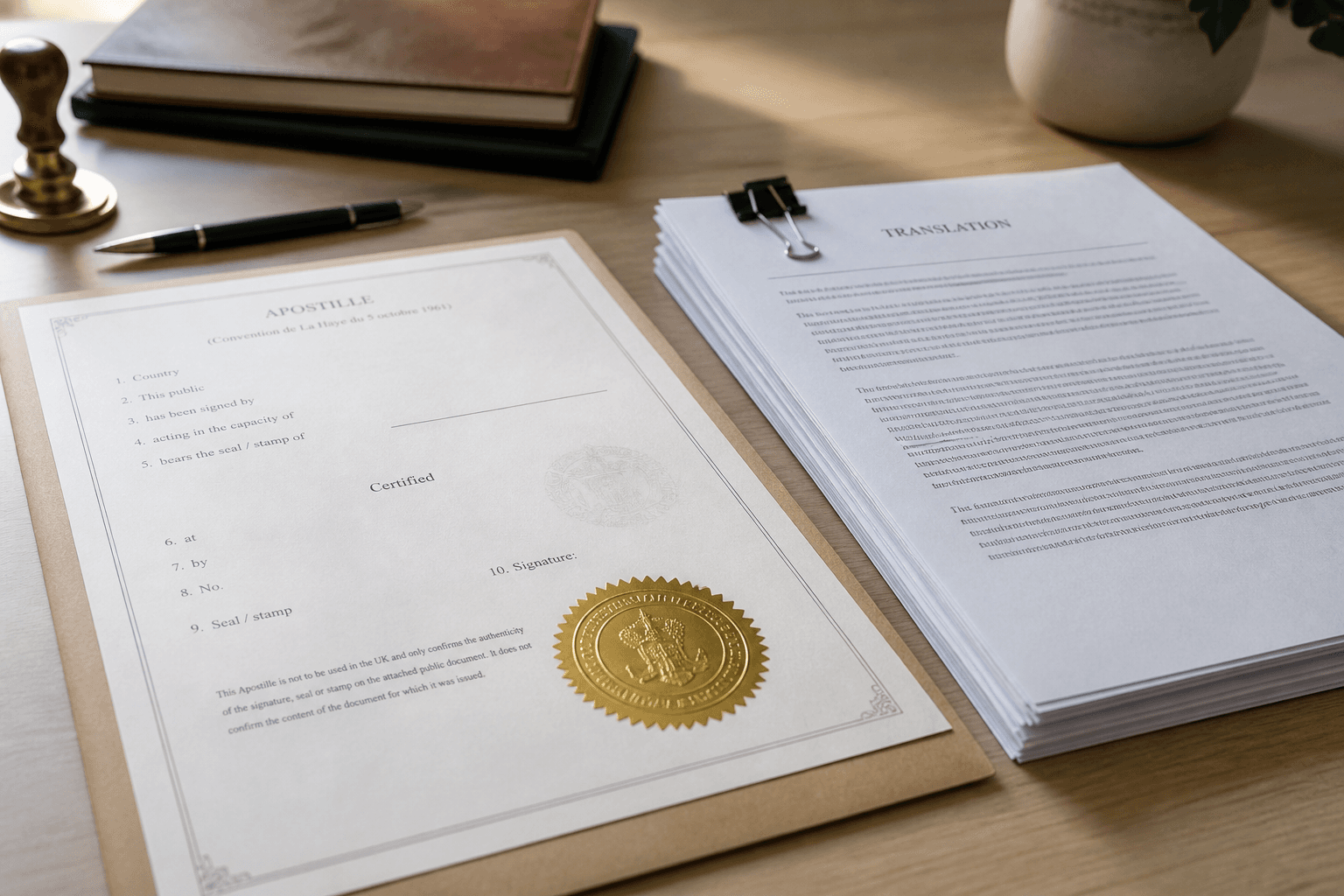

An apostille legalises the original, not the translation
Start with the object. A birth certificate, a diploma issued by a public university, a court extract, a notarial deed — these can be public documents. An apostille is attached to that public original (or to a copy the competent authority treats as eligible) and says, in a standard form, that the signature and seal on it are genuine. A clerk in another Hague country can then skip the older consular chain.
A translation is a different object. It is a linguistic rendering. Even a perfect translation does not prove that the registrar in Lviv or the dean in Wrocław really signed the source. That proof is what the apostille is for. Mixing the two is how people end up with a beautifully translated certificate that a foreign office still rejects because the original was never legalised — or with an apostilled original that nobody in the destination language can read.
PRAVIS certifies translations with a bureau seal: stamp, accuracy statement, reference number. That seal speaks to the translation. It does not impersonate a competent authority. If a website promises apostille plus translation as if one shop prints both stamps, read the small print. We will not print an apostille. We will tell you which kind of Polish or foreign authority usually handles your document type, then translate once the original’s legalisation status is clear.
This distinction matters for search intent. People type апостиль до чи після перекладу because a forum mixed the stamps. The short citable answer: apostille belongs on the public original; translation comes after, covering the original text and usually the apostille certificate itself.
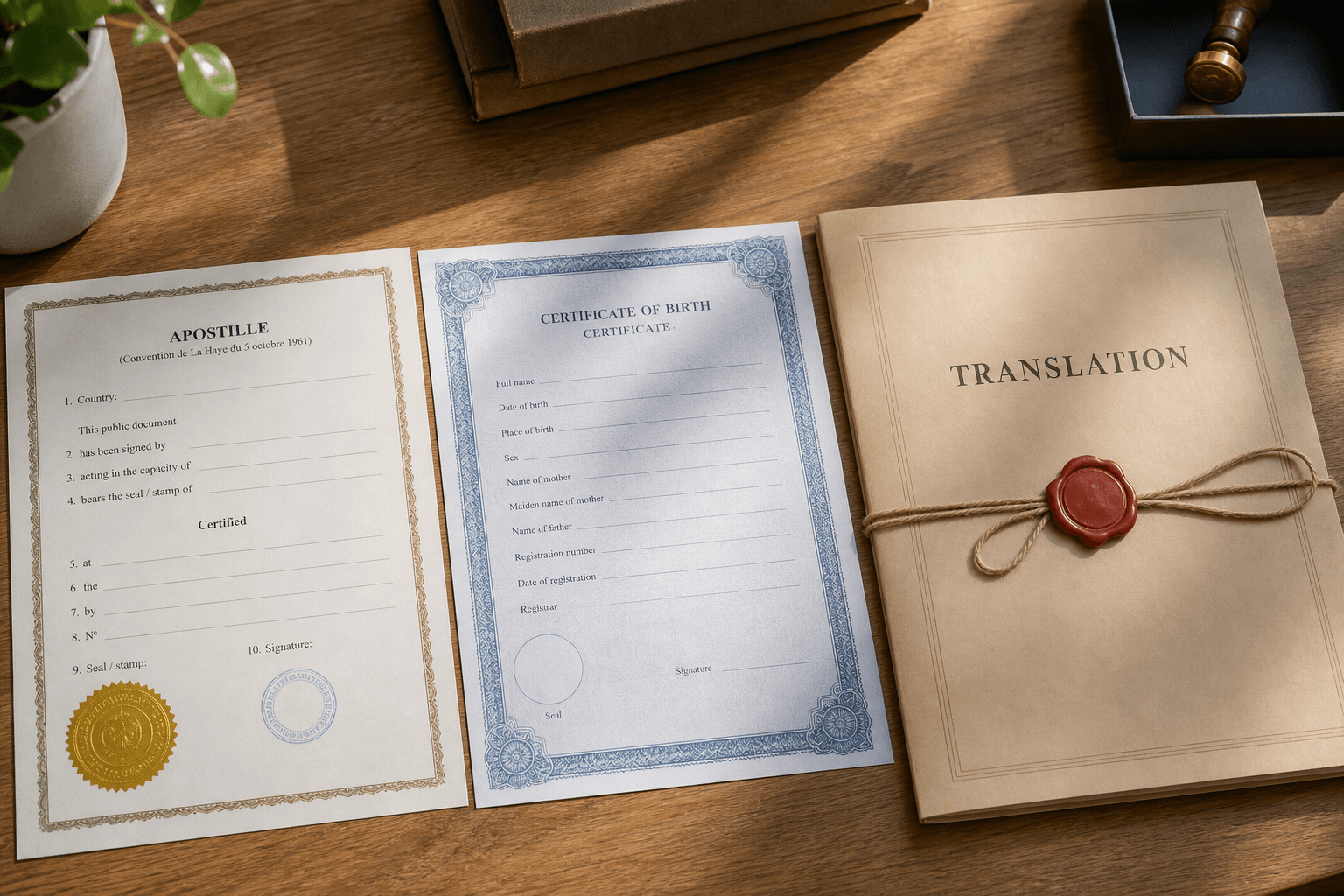
Typical order: apostille first, then translate document and certificate
Unless the receiving office has written a different sequence, work in this order. First, confirm that the destination country is in the Hague Apostille system and that the office actually wants an apostille, not consular legalisation. Second, take the original public document (or the copy the issuing state will apostille) to the competent authority and obtain the apostille. Third, send us a complete scan of every page, including the apostille leaf or stamp, so we can produce a certified translation of the record and of the apostille certificate if the office wants both in the destination language.
Why translate the apostille page too? Because the certificate is itself a public form with names, dates, and a convention heading. A school or a visa centre that does not read the language of the competent authority still needs to see that an apostille exists and what it covers. Translating only the birth certificate and leaving a French or Polish apostille page untranslated is a common reason a clerk sends the file back.
Why not translate first as a default? Because an apostille authenticates the original officer’s seal. If you translate first and then try to apostille the translation, you are asking the competent authority to legalise a translator’s signature — which is a different, less common procedure, used when the office explicitly wants a sworn translator’s signature apostilled. Doing that by accident wastes fees and time.
PRAVIS quotes the translation after we see the apostilled scan, or we quote a two-step plan: you obtain the apostille, then we translate. The apostille timeline is the authority’s, not ours. We will not invent a government queue. Five to seven minutes is the quote for our work, not for the ministry desk.
Send a scan — we will recommend apostille order and translation format
Attach the document, say whether it already has an apostille, and name the receiving office. In five to seven minutes we tell you the typical sequence, whether a PRAVIS bureau seal is enough, and the price for our translation — not a government stamp we do not issue.
Send files nowHague 1961: who issues an apostille, and why it is not PRAVIS
The Convention of 5 October 1961 abolished the requirement of legalisation for foreign public documents among contracting states and replaced that chain with a single apostille form. Each state designates competent authorities. In practice that can be a ministry of foreign affairs, a regional court, a notarial chamber, or another named office depending on whether the document is civil-status, educational, judicial, or notarial.
Poland is a party. Ukraine is a party. The United States is a party. The United Kingdom is a party. That does not mean every document from those countries needs an apostille for every use. A private clinic in another city may only want a certified translation of last year’s bloodwork. A rental desk wants a licence translation next to the plastic card. Apostille is for public documents that a foreign public office or a checklist has asked to see in legalised form.
PRAVIS is not on any competent-authority list. We cannot stamp an apostille, backdate one, or accelerate a ministry queue. What we can do is look at the document category and the destination, tell you which authority typically apostilles that category in the country of origin, and refuse to start a translation that will be wasted if you still need the original legalised first.
If the destination is not in the Convention, an apostille will not help. You are then in consular legalisation — multiple stamps, usually slower. Tell us the country before you pay for the wrong track. We still do not run consulates; we only keep you from translating into a dead end.
Exceptions exist — the receiving office always wins
Typical is not the same as universal. Some universities ask for a translation first and then an apostille on a notary’s certification of the translator’s signature. Some Polish procedures want a tłumacz przysięgły on the foreign act, and the apostille question sits on the original in the country of birth, not on our PDF. Some employers do not want an apostille at all and will be confused if you staple one on.
Always ask the receiving office, in writing if you can, three things: do you need an apostille on the original; do you need a translation of the apostille certificate; do you need a bureau-certified translation or a Polish sworn translator. Paste those answers into the email with the scan. A sentence from the current checklist beats a general article — including this one — because checklists change.
We will not override a written instruction from USC, a wojewódzki office, a consulate, or a university because a blog prefers apostille-first. We will also not hide behind apostille-first when your office has clearly asked for the other sequence. The quote will name the sequence we are following and why.
If the office will not answer emails, we can tell you what similar files usually needed. That is experience, not a guarantee. You remain responsible for confirming with the institution that will actually open the envelope.
How apostille order interacts with bureau seal versus przysięgły
Two stamps, two jobs. The apostille speaks to the original public document. The translation certification speaks to the language. You can need both, one, or neither. A school enrolment abroad often needs a bureau-seal certified translation and no apostille. A foreign birth certificate entering a Polish USC file often needs an apostille on the original plus a sworn translation, not a bureau seal. A USCIS-style pack may want a certified translation of an already apostilled civil-status act. None of those sentences is a visa promise.
PRAVIS’s core product remains certified translation with the bureau seal. We use it on apostilled originals when the destination is a school, a private clinic, a rental company, or a non-EU pack that asked for certified translation in the US or UK sense. We switch to a registered tłumacz przysięgły when a Polish sąd, USC, or some urząd wojewódzki / karta pobytu line item requires sworn form. The apostille does not decide that switch. The receiving office’s legal category does.
A common expensive mix-up: people apostille a document, then pay for a przysięgły translation because apostille sounded official, then discover the foreign school only wanted a bureau-certified English file. Official is not a single product. Match each instrument.
When both are in play, the practical pack from Wrocław is usually: original with apostille (you obtain), certified translation of document plus apostille page (we produce, bureau seal unless sworn is required), PDF first, paper by tracked mail if the office wants wet ink.
Documents that trigger this question most often
Birth certificates lead the queue. Families moving a child’s record between Ukraine or Poland and another Hague country are told to apostille the act, then translate it. Marriage and divorce certificates follow the same pattern when a foreign registry or a surname change is involved. Diplomas and diploma supplements appear when a university abroad asks for legalised education documents rather than a simple certified transcript.
Criminal-record certificates for long-stay files are another cluster: the issuing police or ministry document may need an apostille, then a certified translation. Powers of attorney and notarial deeds sit in a stricter group: the notarial original is often apostilled, and the translation format may be sworn depending on who will use the deed.
Lab results, vaccination cards, and driver’s licences usually do not belong in the apostille conversation at all. They are everyday certified-translation jobs. Forcing an apostille onto a private clinic printout wastes weeks. If you are not sure which bucket your paper is in, that is exactly what the scan review is for.
Tell us the document type, the country that issued it, and the office that will receive it. We separate apostille advice from the translation quote. You pay us for translation and format recommendation, not for a government stamp we cannot apply.
Mail from Wrocław: scans first, originals only when agreed
Most of the work is digital. You photograph or scan every page, including hinges, seals, and the apostille sheet. We quote in five to seven minutes. After you approve, we deliver a certified PDF. That is enough for many schools and visa centres that accept electronic certified files.
Some offices still want paper: a printed translation with a wet seal, sometimes the original returned in the same envelope. Then we mail from Wrocław by registered post or courier. Contact us first so the recipient line is exact — name, apartment, any unit number. Keep the tracking number. Do not drop an irreplaceable civil-status original in a mailbox until we confirm that we need the paper at all.
We do not keep a fake branch address in another city. If you live in Warsaw or Gdańsk, the parcel still originates in Wrocław. That is slower than a fictional local counter and safer than sending originals to a coworking plaque.
Email: office.pravis@gmail.com. If you are mid-apostille at a ministry, send the scan of the original now and the apostille page the day you collect it; we can plan the translation without pretending the apostille already exists.
What we can promise, and the next step
We can promise a careful read of your scan, an honest split between apostille (not us) and translation (us), a typical-order recommendation of apostille first unless your office wrote otherwise, and a bureau-seal certified translation as the default product — with a sworn path flagged when Polish court or USC procedure requires it. We can promise a quote in five to seven minutes for our part.
We cannot promise the ministry’s waiting time. We cannot promise that a named consulate, university, USCIS, UKVI, or urząd wojewódzki will accept the combination you submit. We cannot promise a visa, a residence card, or a place at school. Those outcomes are not translation products.
Author of this guide: Hanna Velyka. The desk rule is the same as the article: legalise the original with the competent authority, translate after, include the apostille certificate in the translation when the office will read it, and never confuse a bureau seal with a government apostille or a przysięgły repertorium number.
Send the scan. Name the receiving office. Ask whether you should apostille before we translate. We will answer with a sequence and a price for the work that is actually ours.
Frequently asked questions
Should I apostille before or after the translation?
Typically before: apostille the original public document, then translate the document and the apostille certificate if the office wants both. Always follow a written instruction from the receiving office if it differs. PRAVIS does not issue apostilles.
Does an apostille replace a certified translation?
No. An apostille authenticates the original’s signature and seal. A certified translation makes the text readable in another language. You may need one, both, or neither, depending on the office.
Does PRAVIS issue apostilles?
No. Competent authorities do — a ministry, court, or notarial chamber, depending on the document. We advise on typical order and translate once the original is ready. Mail of paper sets is from Wrocław.
Do I translate the apostille page as well?
Often yes, if the receiving office does not read the language of the competent authority. Tell us what the checklist says. We include the apostille certificate in the certified translation when that is the usual request.
Bureau seal or tłumacz przysięgły on an apostilled document?
The apostille does not decide. Schools, clinics, rental desks, and many USCIS/UKVI-style packs use a PRAVIS bureau seal. Polish sąd, USC, and some wojewódzki steps need a sworn translator. Send the office name with the scan.
Will this combination get my visa or karta pobytu approved?
We do not promise immigration outcomes. A correct order and certification format help a clerk read the file. The decision belongs to the receiving authority. Quote for translation: five to seven minutes via office.pravis@gmail.com.