
Guide · certified vs sworn
Certified vs sworn translation: bureau seal or tłumacz przysięgły?
People who search certified vs sworn translation are rarely looking for a lecture on legal theory. They are holding a scan of a school record, a lab result, a driver’s licence, or a civil-status certificate, and a receiving office that used a word it did not explain. In the United States and the United Kingdom, certified translation usually means a professional translation plus a signed statement of accuracy. In Poland, tłumaczenie przysięgłe means something else: a translation entered in a sworn translator’s repertorium by a person appointed by the Minister of Justice. Those two formats are not interchangeable, even when English marketing copy pretends they are. PRAVIS is a certified translation bureau in Wrocław. Our core product is a certified translation with the PRAVIS bureau seal — not a sworn (przysięgły) translation as the default offer. That bureau-seal format is what schools, private clinics, car-rental desks, and many non-EU visa packs actually ask for when they write certified translation in the USCIS or UKVI sense. When a Polish court, an USC office, or some urząd wojewódzki steps legally require a tłumacz przysięgły, we say so before you pay. We do not promise visa or immigration outcomes. Send a scan and the name of the receiving office to office.pravis@gmail.com; a human quote takes five to seven minutes.
Hanna Velyka · 18 August 2026


What a bureau-seal certified translation actually is
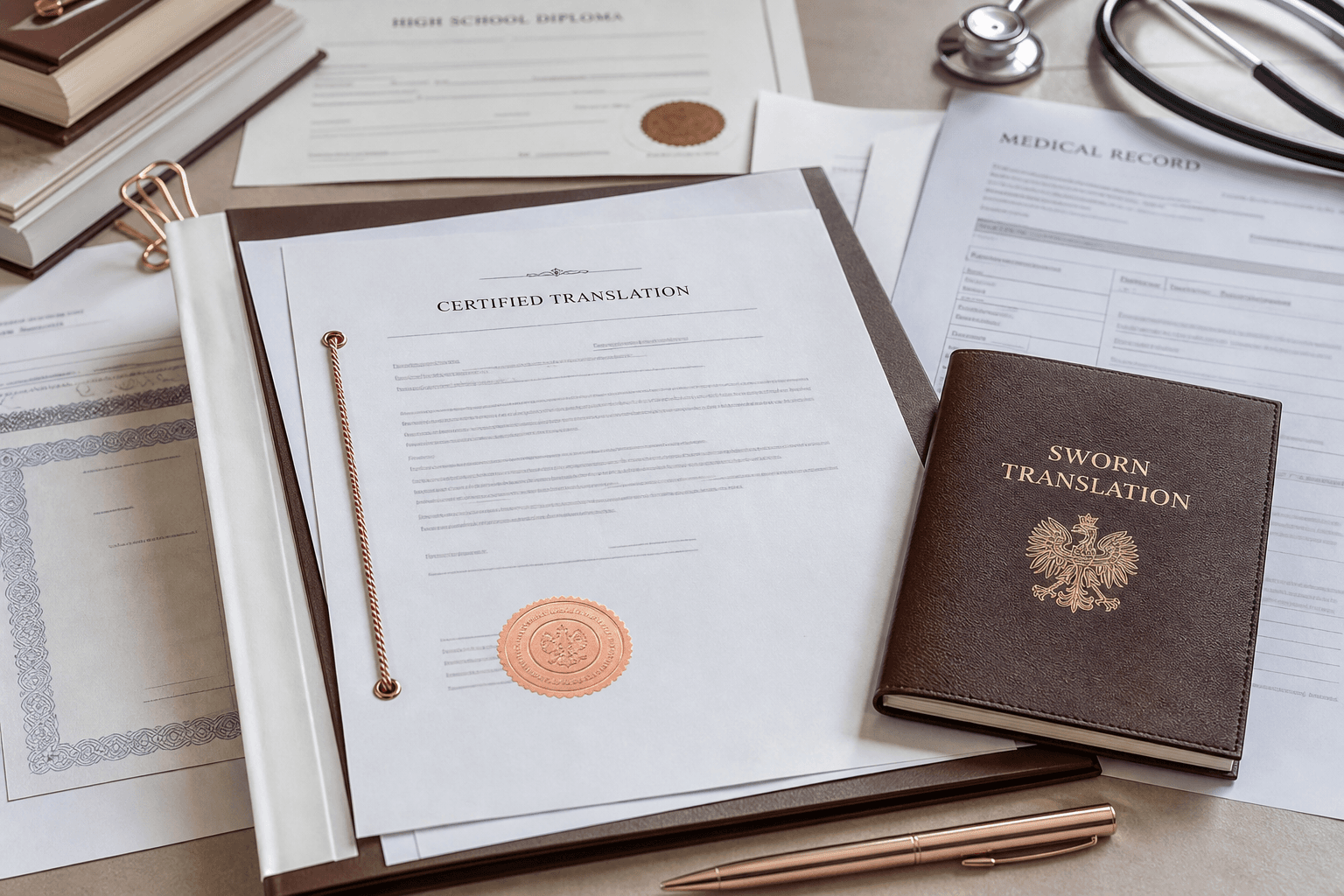
A bureau-seal certified translation is a professional translation that a translation company stands behind as a company. At PRAVIS that means four visible things on the finished file: the official bureau seal, a signed statement that the translation is complete and accurate to the best of our knowledge, a unique reference number, and our contact details so a school, clinic, insurer, or visa centre can verify the source. The translator who produced the text is a professional; the certification is issued by the bureau, not by a court-appointed individual.
That model exists because most receiving offices outside Polish courts do not need a Polish public officer. They need a readable, complete rendering of names, dates, stamps, and grades, plus a named organisation that will answer if someone calls. A school registrar in another country, a private clinic, a car-rental desk, or a visa-pack checklist written in the USCIS or UKVI style is usually asking for that package — even if the checklist simply says certified translation.
What the seal does not do is convert the document into a Polish court exhibit or an USC filing. It does not replace an apostille on a public original. It does not create a new legal status for the underlying record. It certifies the translation. If you need the original itself legalised, that is a separate competent-authority step; PRAVIS does not issue apostilles.
For everyday document work this is the format we produce every week from Wrocław: school transcripts, vaccination cards, discharge summaries, driver’s licences presented alongside the plastic original, employment letters, and civil-status certificates used abroad where the office has not asked for a tłumacz przysięgły. You send a clear scan; we confirm price and turnaround in five to seven minutes.
What Polish tłumacz przysięgły and repertorium actually mean
A tłumacz przysięgły is not a marketing badge. It is an individual appointed by the Polish Minister of Justice, entered in the official register of sworn translators, and authorised to use a personal round seal. That person keeps a repertorium — a numbered register of sworn translations — and each official translation carries a repertorium number. The legal weight sits on that person, not on a company logo.
Polish law uses that figure for situations where the state wants a named public-trust translator: court filings (sąd), most civil-registry work at USC, some notarial acts, and a subset of wojewódzki procedures where the office’s written instruction says tłumaczenie przysięgłe. If an USC clerk is registering a foreign birth or marriage certificate into the Polish civil register, they are usually not looking for a bureau stamp. They are looking for a sworn translator’s seal and repertorium line.
PRAVIS does not pretend that our bureau seal is a przysięgły seal. Those are different instruments. When your case falls into a sworn-required category, we tell you during the scan review — before money changes hands — and we can arrange a sworn translation through registered tłumacze przysięgli in our network. That path is slower and priced differently from our core bureau-seal service, because it is a different legal product.
The practical test is not how important the document feels to you. A driver’s licence can feel vital at a rental desk and still only need a bureau-certified translation. A one-page foreign birth certificate can feel ordinary and still need a przysięgły for USC. The receiving office’s legal category decides, not the emotional weight of the paper.
Send a scan — we will recommend the format
Attach the document and the name of the receiving office. We reply in five to seven minutes with whether a PRAVIS bureau seal is enough, whether a tłumacz przysięgły is required, and a fixed price for our part. No visa promises — a format recommendation you can act on.
Send files nowUS and UK certified translation is not Polish sworn status
English-language checklists cause most of the confusion. USCIS-style instructions typically ask for a complete translation into English plus a certification from the translator or translation company that the translation is accurate and that the translator is competent. That is an accuracy statement. It is not an appointment by the Polish Ministry of Justice. UKVI-style and many UK university or NHS-adjacent checklists use similar language: certified translation, translator’s credentials, contact details, a statement of completeness.
If you take that US or UK wording and assume it means you must hire a Polish tłumacz przysięgły, you often overbuy a format the destination will not even recognise as their certified product. A Polish sworn translation is written for the Polish legal system. A USCIS or UKVI officer is usually checking that someone accountable produced a full English rendering — names spelled consistently, no omitted stamps, a signature and date on the certification. A PRAVIS bureau-seal certified translation is built for that accountability model.
The reverse mistake is just as expensive. If a Polish sąd or USC asks for tłumaczenie przysięgłe and you submit a bureau-certified PDF because an American blog called it certified, the clerk can refuse the file. Certified in California and przysięgły in Wrocław are false friends. We see this weekly: families who paid for the wrong stamp, then had to start again.
Notarized is a third word in this pile. A US notary public typically notarises a signature, not the linguistic accuracy of a translation. A Polish notary is a different officer again. Notarizing a translator’s signature does not magically create a przysięgły translation, and it is not automatically what USCIS means by certified. If a checklist says notarized translation, send us the exact sentence from the office. We will tell you whether they likely mean a notary, a bureau accuracy statement, or a Polish sworn translator — without promising that any consulate will accept the result.
When the PRAVIS bureau seal is enough
The bureau seal is the right tool when the receiving office needs a professional, verifiable translation and has not specified a Polish court-appointed translator. The cases we see most often are ordinary and high-stakes at the same time: a child changing schools, a private clinic wanting last year’s imaging report, a rental company that will not hand over keys unless the licence text is in a language their desk recognises, an employer HR file, an insurer, a university admissions office outside Poland.
School and university files are the largest group. Transcripts, diplomas, enrolment letters, and reference letters going to a foreign admissions office are usually certified in the bureau-seal sense. The office wants grades and names to match the original; it is not opening a Polish civil case. Medical files for private clinics, occupational health, and travel insurers follow the same pattern: completeness and a named bureau matter more than a repertorium number.
Driver’s licences for car rental sit in this group almost every week. You still present the plastic original. The certified translation travels next to it. Rental companies set their own rules, so we never promise that a particular brand will accept a given file — we produce the standard certified format and tell you to confirm with the desk if you can.
Many non-EU visa document packs written in the USCIS or UKVI certified-translation style also belong here: civil-status certificates, diplomas, employment letters, and police certificates translated with an accuracy statement. That is a format recommendation based on how those checklists are worded, not a prediction that a visa will be granted. PRAVIS does not decide immigration outcomes and will not write as if we do. If your pack is for a Polish karta pobytu or a wojewódzki file, read the next section before you assume the same format applies.
When a sworn translator is actually required
A sworn translator is required when Polish public procedure says so, not when a document looks official. The clear clusters are: filings in a Polish court (sąd); most USC procedures that enter a foreign civil-status act into the Polish register; some notarial acts; and some urząd wojewódzki or karta pobytu steps where the written instruction names tłumaczenie przysięgłe or a court-appointed translator.
USC is the example people underestimate. Registering a foreign birth, marriage, or divorce certificate in Poland is not the same as showing that certificate to a school abroad. The civil registry is a Polish legal process. Clerks are trained to look for a przysięgły seal and a repertorium number. A beautiful bureau-certified PDF can still be the wrong instrument.
Karta pobytu and wojewódzki files are mixed, which is why we refuse slogans. Some supporting documents in a residence file are treated like ordinary certified translations. Some attachments are listed as requiring a sworn translator. The only honest method is to read the current instruction for that office and that form, then match the format to the line item. We do that when you send the scan and the office name. We still cannot promise that the voivodeship office will accept the file or that the residence case will succeed.
If we see a sworn requirement during quote review, we stop you from buying the bureau-seal product for that page. You can still order bureau-seal certified translations for the other documents in the same envelope that do not need przysięgły. Mixed packs are normal. Paying twice for the same page because nobody flagged the legal category is what we try to prevent.
Notarized, certified, and sworn are three different requests
Search results mash three requests into one headline. Certified, in the US and UK document sense, is usually an accuracy statement by a translator or bureau. Sworn, in the Polish sense, is a Ministry of Justice appointee with a personal seal and repertorium. Notarized is typically a notary confirming a signature or a copy, not confirming that the Ukrainian diploma grades were translated correctly.
If a US university says notarized translation, they may want a notary’s stamp on the translator’s affidavit, or they may be using notarized loosely. If a Polish notary asks for a sworn translation of a power of attorney, they mean przysięgły. If a car-rental email says certified copy, they may not want a translation at all — they may want a photocopy. The words are cheap; the wrong product is not.
PRAVIS will not upsell a przysięgły translation because it sounds more official. Official for a Wrocław court and official for a Texas school are different. We also will not hide a sworn requirement behind a cheaper bureau seal. The honest middle is a format recommendation tied to the receiving office, delivered in the quote, with the limits written in plain language.
When you are unsure, do not guess from a forum thread dated 2019. Offices change checklists. Send the current sentence from the website, the email, or the paper instruction together with the scan. That single extra line is worth more than a generic certified vs sworn article — including this one — because the article cannot see your clerk’s stamp.
How to decide: send the scan and the receiving office name
The decision process at PRAVIS is deliberately short. You send a readable scan or photo — all pages, including the reverse if there is a stamp — and you name the receiving office: the school, the clinic, the rental company, the consulate, USCIS, UKVI, USC, sąd, or urząd wojewódzki. If you have a checklist sentence, paste it. If you only know the country, say that; we will tell you what we can infer and what we still need you to confirm with the office.
A person reviews the file. Typical turnaround for that quote is five to seven minutes during working hours. The reply is a format recommendation (bureau seal, sworn translator, or a split pack), a fixed price for our part, and a turnaround. If an apostille on the original is in play, we separate that question: PRAVIS does not issue apostilles; the competent authority does. Translation order relative to apostille is a different guide.
We cannot certify a guess. A blurry photo that cuts off the seal, a crop that hides a handwritten note, or a file that omits page two of a diploma supplement will delay the quote because we refuse to invent text. The same honesty applies to outcomes: a correct certification format improves the chance that a clerk can process the paper; it does not grant a visa, a place at school, or a rental car. Those decisions sit with the receiving institution.
Email is office.pravis@gmail.com. If the office later needs a wet-ink paper set, we mail from Wrocław by tracked post or courier after we agree the exact recipient line. Most certified translations leave as a PDF first. You should not post original civil-status documents until we confirm the address and whether we even need the paper original rather than a scan.
Working with PRAVIS from Wrocław without buying the wrong stamp
PRAVIS is a bureau, not a substitute Ministry of Justice. We sell certified translation with our seal because that is the product most international schools, clinics, employers, and non-EU visa packs actually use. We disclose sworn requirements because hiding them would waste your appointment. Both statements can be true at once.
The Wrocław office is the physical hub. There is no fake branch plaque in another city. If you are in Warsaw, Kraków, or Gdańsk, the work still leaves from Wrocław: digital first, paper by mail when the recipient insists. That is slower than a fantasy local counter and more honest than a rented virtual address.
Author of this guide: Hanna Velyka. The operational rule behind it is the same one we use on the quote desk: read the receiving office, match the instrument, do not inflate Polish sworn status onto US or UK certified checklists, and do not deflate a sąd or USC requirement into a bureau PDF. If your case is mixed, the quote will be mixed.
Start with the scan. Name the office. Ask for a format recommendation, not a lucky stamp. We will answer in five to seven minutes with a price for the work we can actually perform — bureau-seal certified translation as the core offer, and a sworn path only where Polish procedure requires it.
Frequently asked questions
Is a certified translation the same as a sworn translation in Poland?
No. A PRAVIS certified translation is certified by the bureau with our seal and an accuracy statement. A Polish sworn translation is issued by a tłumacz przysięgły on the Ministry of Justice register and recorded in that translator’s repertorium. US and UK certified wording is closer to the bureau model. They are not interchangeable.
When is the PRAVIS bureau seal enough?
Typically for schools, private clinics, insurers, employers, car-rental desks, and many non-EU visa packs that ask for a certified translation in the USCIS or UKVI sense. The receiving office still decides. Send the scan and the office name; we recommend a format in five to seven minutes.
When do I need a tłumacz przysięgły?
Usually for Polish courts, most USC civil-registry filings, some notarial acts, and some urząd wojewódzki or karta pobytu steps that explicitly ask for tłumaczenie przysięgłe. We flag this before you pay. Sworn work is not our default product; we arrange it through registered translators when the procedure requires it.
Does notarizing a translation make it sworn?
No. A notary typically confirms a signature or a copy. That does not create a Polish repertorium entry and is not automatically what USCIS means by certified. Paste the office’s exact sentence when you request a quote.
Can you guarantee USCIS, UKVI, or a voivodeship office will accept the file?
No. We do not promise visa, immigration, school, or rental outcomes. We match the usual certification format to the wording of the request and tell you when Polish law points to a sworn translator. Acceptance is always the receiving office’s decision.
How do I start, and do I need to visit Wrocław?
Email a scan to office.pravis@gmail.com or use the quote form, and name the receiving office. Most orders are digital. Paper sets, when required, are mailed from Wrocław. You do not need to visit unless you want to drop off or collect originals.