
Countries · France
Certified translation for documents used in France
Submitting documents to a school, clinic, employer or public office in Paris? PRAVIS prepares accurate translations with the bureau seal and explains the important difference between our certification and a French traduction assermentée. A bureau seal is accepted in many everyday situations, but some préfectures, courts and other official procedures require a translator sworn before a French court.


Documents translated for France
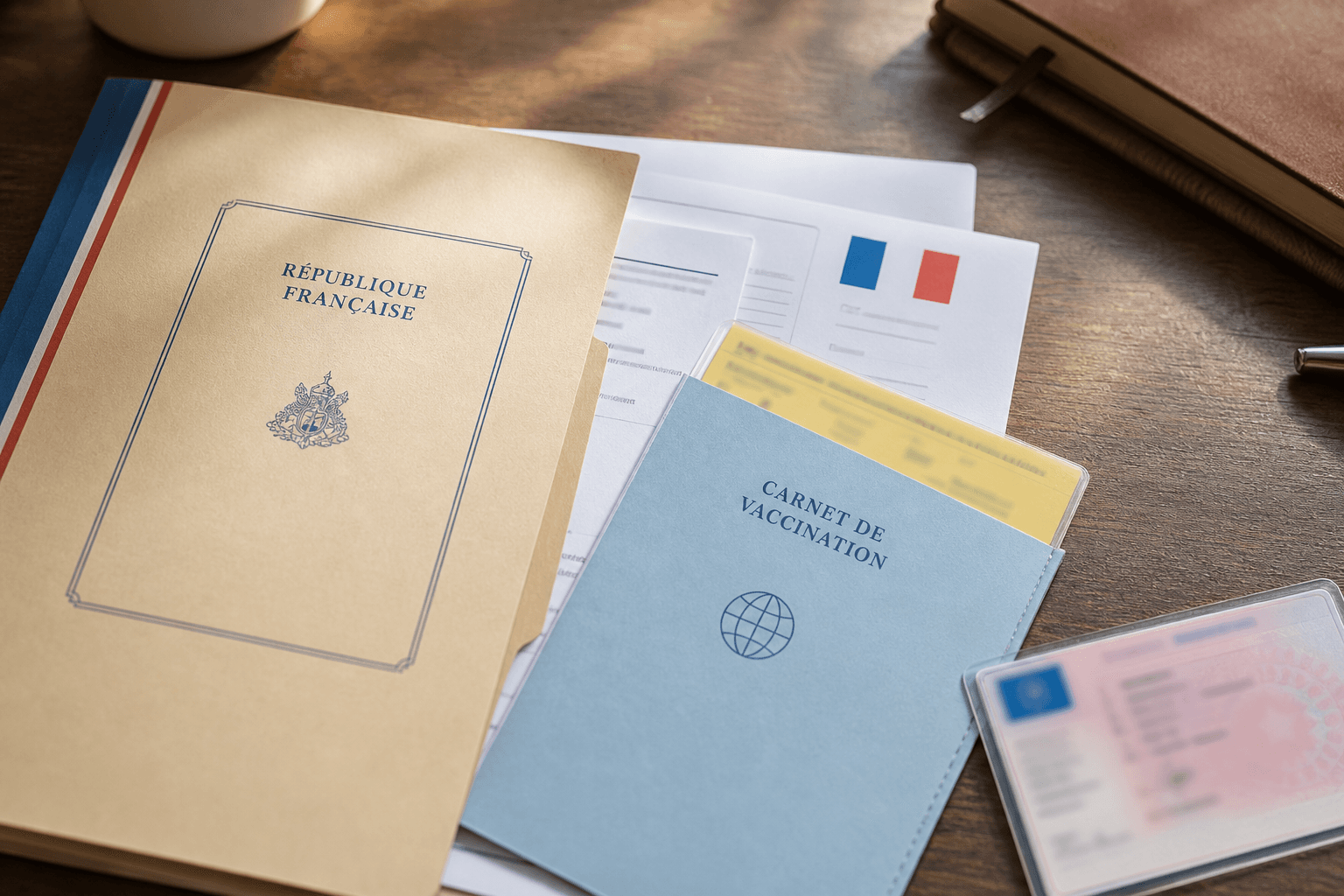
For schools in Paris and elsewhere in France, we translate birth certificates, school-leaving certificates, diplomas, supplements, grade transcripts, attendance letters and admission correspondence. For medical use, clients send patient histories, laboratory results, doctors’ reports, prescriptions, vaccination records and insurance papers. These may support a child’s enrolment, further study, a clinical consultation or an accurate account of previous treatment. We reproduce subjects, grades, stamps and material annotations consistently; we do not alter facts to make a file appear more favourable to the recipient.
We also handle birth, marriage, divorce and death certificates, criminal-record certificates, proof of address and employment, bank and tax papers, powers of attorney, declarations and official correspondence. A driving file can include the licence, an entitlement history and a letter from the issuing authority; a visa or migration file can include invitations and evidence of accommodation, family relationship, employment or funds. Before translation, tell us exactly who will receive the document in Paris or another French city: a private organisation, school, university, ANEF, préfecture, court or other public body. The named recipient matters more than the broad label “visa document” or “school document”, because different bodies can set different rules for the same kind of record.
Bureau seal vs traduction certifiée / assermenté
In international English, “certified translation” can describe a translation accompanied by a bureau’s seal, signature and accuracy statement. That is PRAVIS’s standard service. The French administrative concept of a traduction assermentée is narrower: it is certified by a traducteur assermenté, an expert translator sworn before and listed with a French court. The phrase traduction certifiée in a recipient’s message therefore needs context. If the instructions specify assermenté, expert près la Cour d’appel, a sworn translator’s stamp or an official court-expert list, an ordinary translation-bureau seal is not legally equivalent.
For many everyday uses — a private school or course, an employer, clinical information, an insurer’s review, a tenancy or a company’s internal file — the recipient may accept the PRAVIS bureau seal. A préfecture, tribunal, mairie, notaire, particular university or service processing a civil-status, driving or migration matter may instead insist on a French assermenté translation. Practices can also vary by procedure and office, so another person’s past acceptance is not proof for a new application. We do not describe our bureau certification as sworn and will not recommend it against an unambiguous written requirement. Send the relevant screenshot, link or recipient details; we will explain whether our format fits and say plainly when you need the French assermenté route.
Send your documents for a France format check
Attach the scans and the recipient’s instructions. We will quote the work and tell you honestly whether the PRAVIS bureau seal is suitable or a French assermenté translator is required.
Send files nowApostille notes for France
An apostille authenticates the origin of a signature or seal on a public document for international use. It does not validate the document’s substantive claims and does not replace translation. When a document issued in Ukraine, Poland or another Hague Apostille Convention state is destined for France, any required apostille must normally come from the competent authority in the issuing country. PRAVIS does not issue apostilles. A sensible general sequence is to obtain the apostille first and then translate the complete document, including the apostille wording, number, stamps and signatures, but the French recipient should confirm the sequence before you spend money.
There is an important EU qualification. Regulation (EU) 2016/1191 removes the apostille requirement for certain public documents exchanged between EU member states, including documents covering specified facts such as birth, marriage, domicile or residence and absence of a criminal record. A multilingual standard form can sometimes reduce the need for translation as well. The Regulation does not cover every record, does not automatically validate any photocopy and does not settle every question about the translation format. Diplomas, medical records, private documents and records outside its scope need separate assessment. Do not buy an apostille merely “to be safe”: ask the named préfecture, school, court or other recipient whether it wants an original, certified copy, apostille and/or assermenté translation.
How the process works from Wrocław
Send a clear scan or photograph of every relevant page and tell us the language pair, purpose and receiving institution. Attach any French instructions you have: terms such as assermenté, traducteur agréé, original, copie certifiée and apostille can materially change the right route. We review legibility, page count, seals, handwritten passages and the preferred spelling of personal details against the passport or other identification. We then quote the price, turnaround and proposed certification format. If the PRAVIS bureau seal is unlikely to satisfy an explicit requirement, we flag that before payment rather than producing a document that is foreseeably unsuitable.
Once you approve the quote, the translator prepares the text and the bureau checks and certifies the finished document with the PRAVIS seal. You can receive the certified PDF remotely. When a paper copy is useful, we mail or courier it from our Wrocław HQ to Paris, elsewhere in France or another country; paper originals can also be sent to Wrocław when the job genuinely requires them. Courier time is separate from translation time, so leave a margin before a préfecture, school or court deadline. We can explain practical document-format issues, but we are not the deciding authority. Neither a precise translation nor apostille guidance can guarantee a visa, titre de séjour, driving-licence exchange, admission, medical reimbursement or any other outcome.
Frequently asked questions
Will France accept a translation with the PRAVIS bureau seal?
Many private schools, employers, clinics and other everyday recipients do. If a préfecture, court or other authority explicitly asks for a traducteur assermenté, the bureau seal does not replace that format.
How is a PRAVIS translation different from a traduction assermentée?
PRAVIS certifies the translation with the bureau seal and an accuracy statement. In France, a traduction assermentée is produced by a translator sworn before a French court; that is a distinct legal status.
Do you translate school, medical and driving documents for Paris?
Yes. We translate all three categories, but the required certification should be checked with the particular school, clinic, préfecture or other service receiving the file.
Does my document need an apostille for use in France?
It depends on the issuing country, document type and procedure. Some EU public documents are exempt; in other cases the competent authority in the country of origin issues the apostille.
Can I order online and receive a paper translation in France?
Yes. A legible scan is usually enough for assessment; we deliver the PDF electronically and can mail or courier a stamped paper copy from Wrocław.
Does a certified translation guarantee a French visa or titre de séjour?
No. We are responsible for the translation and stated certification format, while the competent French authority alone decides the visa, residence or other application.